

Abogados Aertken

Inheritance in SpainPlanning today protects tomorrow.

I help you put your assets in Mallorca in order in good time, and I guide heirs through the process of inheriting a property in Spain.
Get in touch
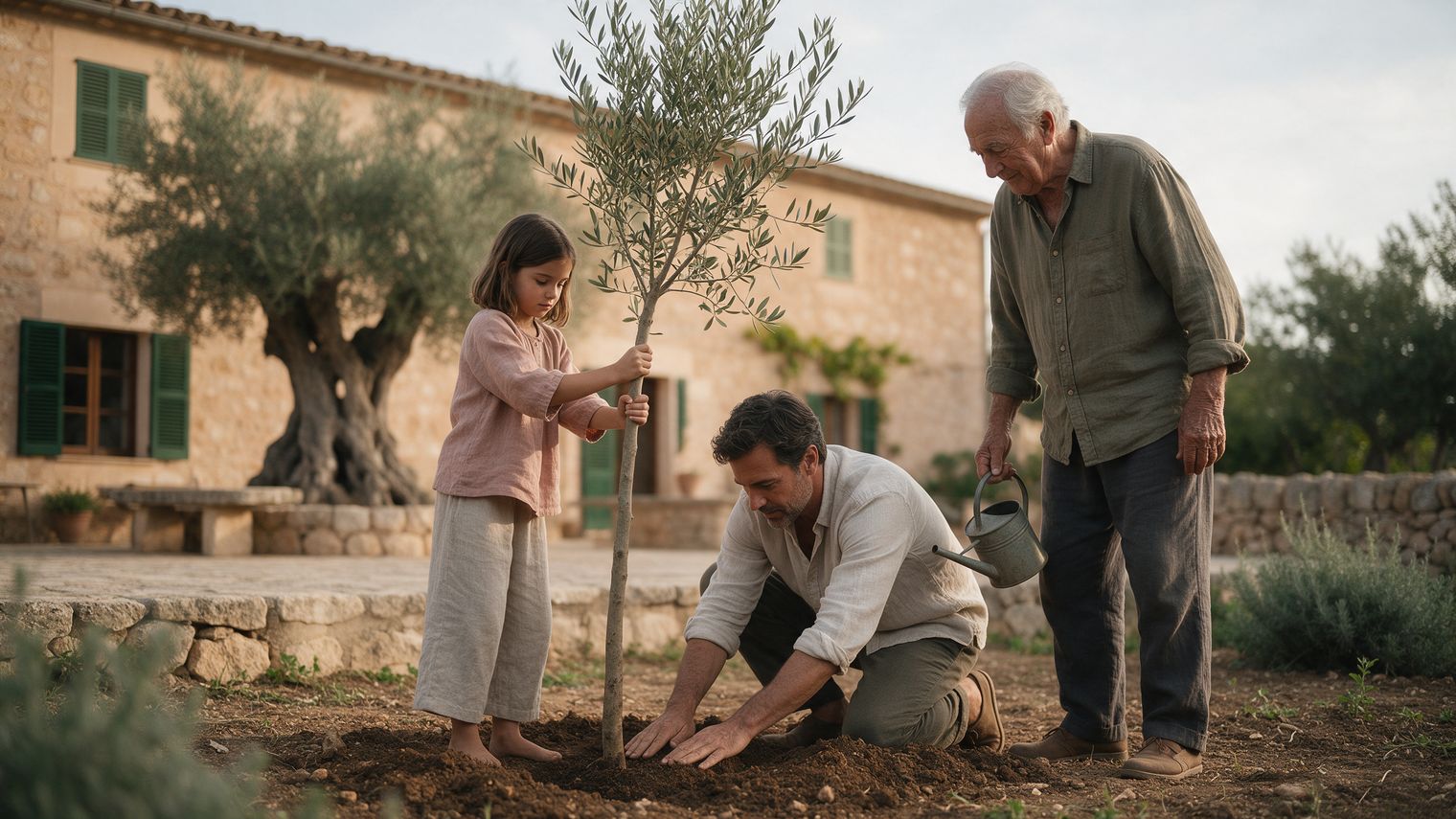
Three generations planting an olive tree in front of a house in Mallorca

A will in Spain – the right path for you?

Many foreign owners of property in Mallorca already have a will in their home country. Whether an additional will in Spain makes sense cannot be answered across the board: it can make things easier for your heirs – but it can also make them harder if several wills have to be taken into account and it is unclear how they relate to each other.

Whether a will in Spain is the right path for you is something we decide together, case by case. If we opt for one, I coordinate it with your existing will – otherwise the later will may revoke the earlier one in whole or in part.

With a Spanish will

The Spanish notary can work with the will directly; it is recorded in the General Register of Wills in Madrid. This can spare your heirs translations and additional documents – provided it is coordinated with the will you have in your home country.

Without a will in Spain

In that case, the will from your home country applies or, if there is none, the statutory rules of succession. Your heirs must prove their right to inherit in Spain, for example with a German certificate of inheritance (Erbschein) bearing a Hague Apostille or with a European Certificate of Succession, together with a translation. This is a common route – and sometimes the simpler one.

Inheriting a property in Spain – how it works

  1. 01

    Gather the documents

    International death certificate, will or proof of inheritance, and a certificate from the Spanish General Register of Wills: I tell you what is needed and obtain the Spanish documents for you.

  2. 02

    The heirs' NIE

    Every heir needs an NIE to accept the inheritance in Spain and file the tax return. If you wish, I take care of the application.

  3. 03

    Accepting the inheritance before a notary

    The heirs accept the inheritance in a notarial deed and divide the estate. You do not need to travel for this – I can represent you under a power of attorney.

  4. 04

    File the inheritance tax return

    Spanish inheritance tax must be declared within six months of the death, plus, where applicable, the municipal tax on the increase in land value. I calculate both under the current rules and file the returns for you.

  5. 05

    Registration at the Land Registry

    Finally, the property is registered in the heirs' names at the Land Registry. Only then can you sell, let or mortgage it without difficulty.

Questions on wills and inheritance

What owners and heirs ask me.

See all questions →

Not necessarily. A will made in your home country – in Germany, for example – can also cover your assets in Spain. Whether a will in Spain is the right path for you is something we decide together, case by case. An additional Spanish will can make the process easier. But several wills can also make it harder if it is unclear how they relate to each other – both in Spain and in your home country. If we opt for a will in Spain, I coordinate it with your existing one.

Since 2015, the EU Succession Regulation has applied: what counts is the law of the country in which you last had your habitual residence. If you live in another country – Germany, for example – that country's law will generally apply, including to your property in Mallorca. If you live in Mallorca, Spanish law applies in principle. In your will, you can instead choose the law of your nationality. I assess which solution suits you case by case.

Property in Mallorca is subject to Spanish inheritance tax – under the rules of the Balearic Islands, which grant considerable tax relief to spouses and children. The return must be filed within six months of the death. If the deceased or the heirs live in Germany, German inheritance tax may also be due; the Spanish tax is then generally credited against it. Allowances and rates change – I will tell you the current position for your case.

Much of it, yes. With a notarial power of attorney, I can represent you before the notary, the authorities and the registries. You sign the power of attorney before a notary in your country of residence (with an apostille) or at the Spanish consulate. Whether individual steps require you to be present in person – at the bank, for example – is something I clarify with you in advance.

Settle today what matters tomorrow.

Tell me whether you want to plan ahead or have already inherited. I reply personally.

Get in touch

Checklist

Inheritance guide and checklist

Which documents do we need?

The heirs

  • NIE numbers

The deceased

  • International death certificate
  • German certificate of inheritance (Erbschein) with a Hague Apostille and a certified translation, or European Certificate of Succession (I prefer the Erbschein)
  • The deceased's will, with a Hague Apostille and a certified translation
  • Copy of ID, NIE number

The estate

  • Property: Land Registry extract, cadastral data and, where applicable, the purchase deed
  • Account: statement of the balance on the date of death and the account statements for the previous year
  • Car: vehicle documents
  • Other assets, e.g. golf club shares: proof of ownership

Process

With the necessary documents, we apply to the General Register of Wills in Madrid for a certificate showing whether the deceased had made a will in Spain.

Once all the details and documents are available, I prepare the acceptance of the inheritance with the notary's office. The heirs can sign it in person, or I can sign it on their behalf under a power of attorney. I pass the heirs' tax payments on to the tax office and take care of notifying the authorities, transferring registrations and entering the heirs as owners at the Land Registry.

Last updated: 10/2026 · Does not replace individual advice.

Inheritance

Wills in Spain

Why make a will in Spain if I already have one in Germany? Quite simply: to settle your estate clearly and to avoid Spanish authorities having to interpret your German will. You also do your heirs a favour, because once a Spanish will is presented, other documents that would have to be obtained in the deceased's home country (often expensive and cumbersome) are no longer needed. That has been the prevailing view for many years.

In my many years of practice, however, I have found that things often become more complicated when several wills made by non-resident testators have to be taken into account when the estate is being settled, and it is unclear how each will should be treated – both in Germany and in Spain. More than once I have wished the testators had simply made their will in Germany. So whether a Spanish will makes sense or may cause confusion always has to be decided case by case.

In any case, it is important that you bear the following points in mind:

1. Differences for residents and non-residents: which law applies, and can I choose?

First of all: you can only choose the substantive law, i.e. the options for disposing of your estate. The obligation to pay tax always remains subject to Spanish tax law.

If you are not resident, the choice of law is fairly simple: as a rule, the law of your habitual residence applies, which usually goes hand in hand with your nationality. Nevertheless, this point should be mentioned in the will.

If you are resident in Spain but hold another nationality, you can now choose which of the two laws applies: whether you would rather make your dispositions under Spanish law or under the law of the country of your nationality. Which is better in your case, or better suits your needs, should be clarified in a consultation.

2. The wills must not contradict each other

If another will already exists, it must be checked against the document to be drawn up here. Otherwise, the testator's wishes may not be able to be carried out. A contradiction can often be avoided if the will in Spain refers exclusively to assets in Spain. But have this checked beforehand. It is equally important that, whenever the German will is changed, the Spanish will is taken into account and, if necessary, amended here as well.

3. Is a joint will also possible in Spain?

Spanish law does not recognise the joint will as a legal instrument. However, if the will is made under a law that allows this form, such as German law, the notary can execute a joint will.

4. Can I get my will in German?

If the notary executing the will speaks German, they may agree to draw up the will in both languages.

5. Where is it kept?

The notary's office reports the will to the Central Register of Wills (Registro General de Actos de Última Voluntad) in Madrid. When the testator dies, a certificate must be obtained from there showing when and where the last – and therefore valid – will was executed. The will is also kept in the archive of the notary who executed it, and you receive a copy.

6. Costs

Fortunately, the cost of a will in Spain does not depend on the value of the estate, which makes it much cheaper than in Germany in most cases.

If you have any further questions, I'm happy to help at s.aertken@abogadosaertken.com

Last updated: 10/2026 · Does not replace individual advice.

Inheritance

Inheriting in Spain

When an inheritance arises in Spain, heirs are often overwhelmed by the bureaucracy and the procedures involved. That is more than understandable: you have just lost a loved one and, in most cases, you neither speak the language nor know what is required for the deceased's assets to pass to the heirs.

In Spain, a formal acceptance of the inheritance before a Spanish notary is required, for which numerous documents from the deceased's country of residence must be presented. There is no quasi-automatic transfer of title here, as many know it from Germany. Nor are bank accounts simply closed and transferred to the heirs. Instead, banks are required to freeze the deceased's accounts as soon as they learn of the death. Please note that, from then on, no transactions can be made on the account even with a power of attorney. Spanish law does not recognise a power of attorney that remains valid after death.

It is also important to know that heirs need a Spanish tax identification number for the assets to be transferred into their names.

Once all the necessary documents are available, the formal acceptance of the inheritance prepared with the notary can be signed. The taxes must then be paid, and the transfer of title can be applied for with the authorities.

Inheritance tax

This brings us to the far less pleasant part: inheritance tax. Spain and Germany have no double taxation agreement covering inheritance tax. Spain will always take the position that inheritance tax on a property located here is also payable here – under Spanish rules and tax tables, of course, which differ greatly from the German ones. Even for spouses or children, the tax-free allowance is very limited, at €15,956.87. However, assets in the estate worth up to €700,000.00 are taxed at only 1%. Under certain circumstances, a 100% tax relief can also be applied to inheritances between spouses or between parents and children (current as of 2026).

For amounts above that threshold:

The heir does, however, have some influence on the tax payable, as they declare the value of the inheritance themselves. But be careful: if the values declared are too low, a tax audit may lead the tax authority to demand interest for late payment and penalties on top of the additional tax. For this purpose, the "valor de referencia" (reference value) was introduced a few years ago, setting a minimum value for taxation. It also determines whether tax is payable at all. If, for property, this reference value is used – or, under the current rule of thumb (2026), increased by 20% – the tax relief can be applied. For higher values, the tax table applies.

Whether the municipal tax on the increase in land value (plusvalía) is then payable to the town hall must be assessed case by case.

Once you own a property, please make sure you meet your obligations as an owner. In Spain, besides paying running costs, community fees and property tax, these include a (notional) income tax for non-residents owning property in Spain (Modelo 210). These are usually small amounts, but the tax authorities do actively pursue them. It is therefore advisable to pay these taxes on time (by 31 December of the following year in each case).

I am happy to help you all the way from applying for the NIE to the change of ownership with the authorities and at the Land Registry. Please send your enquiry to: s.aertken@abogadosaertken.com

Last updated: 10/2026 · Does not replace individual advice.

NIE

The Spanish tax identification number, or "NIE"

In Spain, without the mysterious NIE (Número de Identificación de Extranjeros), you are nobody – you practically don't exist. This means you can't open a bank account, register a car or even acquire property, for the simple reason that taxes have to be paid, and for that you need a Spanish tax identification number: the NIE.

The NIE stays the same for life and replaces any other identification number. For Spanish nationals, this number is the same as their ID card number (DNI – Documento Nacional de Identidad), which likewise stays the same for life.

The NIE can be applied for from abroad at Spanish consulates (each consulate publishes its requirements online) and, of course, here in Spain with the local authorities.

Always required

  • Application form EX-15
  • Valid ID card/passport together with a copy (certified by a notary if in Spain, or certified and bearing the Hague Apostille if certified by a foreign notary; consulates usually only require the original ID document)

If you don't apply in person

  • Notarial power of attorney (if granted abroad: bearing the Hague Apostille and with a certified translation)
  • Authorisations to be able to file the application with the authorities

How long it takes to be issued depends on how busy the authorities are and can range from weeks to months.

If you'd like my help with this, please contact me at: s.aertken@abogadosaertken.com

Last updated: 10/2026 · Does not replace individual advice.

Abogados Aertken
Get in touch

(+34) 971 72 19 66 · Mon–Fri 9:00–13:30

Get in touch

Preferably in writing – I reply personally.

Contact formRecommended · 2 minutesSend an emails.aertken@abogadosaertken.comDirectionsOpen in Google Maps

Mon–Fri 9:00–13:30 · (+34) 971 72 19 66