

Abogados Aertken

Buying property in MallorcaA good purchase starts before you sign.

I support you when buying or selling property in Mallorca – from the checks before you pay the deposit through to registration in the Land Registry (Registro de la Propiedad). Independent of the estate agent.
Get in touch
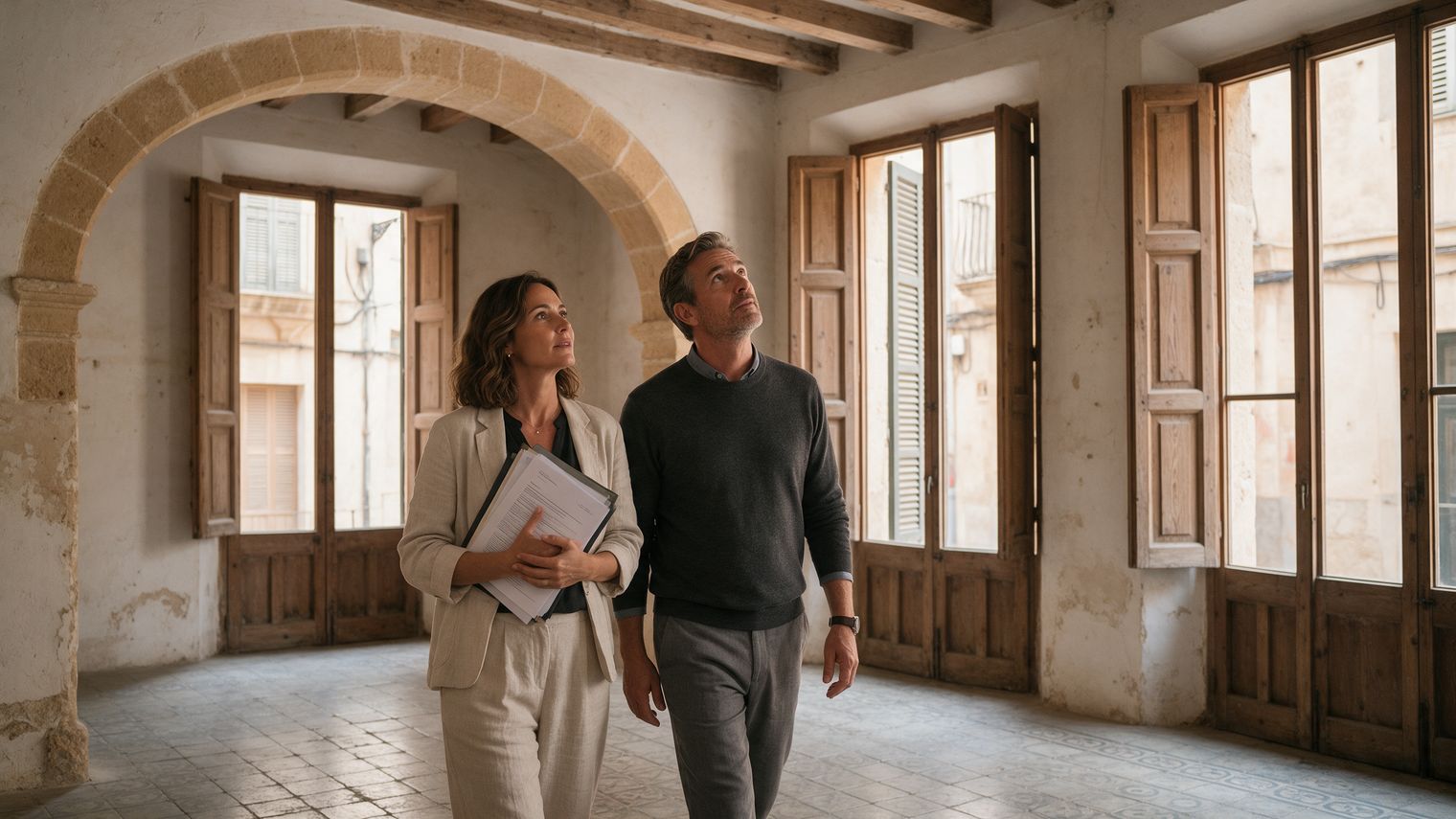
A couple viewing a historic house in Mallorca

Why your own property lawyer – independent of the estate agent?

When you buy property in Mallorca, nobody automatically represents your interests: the estate agent earns on completion, and the notary remains neutral. That's why I check the following for you – before you pay the deposit:

  • Does the property really belong to the seller?
  • Are any mortgages or other charges registered against it?
  • Are all structures authorised, and are the necessary licences in place?
  • Have the property tax (IBI) and community fees been paid?
  • Does the private contract set out what happens to your deposit?
  • How is the deposit secured?

A timely review usually costs less than a mistake after signing.

The buying process in five steps

  1. 01

    Apply for your NIE

    No purchase without a Spanish tax identification number (NIE). I'll show you the quickest way to get one – even if you're still living abroad.

  2. 02

    Legal due diligence on the property

    Before you pay a single euro of deposit, I check the Land Registry, charges, planning and building law, and licences. So you know what you're really buying.

  3. 03

    Private contract and deposit

    The private contract sets the price, deadlines and deposit. I negotiate the terms so it is clear what happens to your money if the purchase falls through.

  4. 04

    Signing at the notary (escritura)

    The purchase is executed as a public deed (escritura pública) before a Spanish notary. I'm at your side – or I represent you under a power of attorney if you can't travel.

  5. 05

    Taxes and registration in the Land Registry

    After the signing, I take care of paying the applicable taxes and registering the property in the Land Registry. Only then is your ownership also protected against third parties.

Questions about buying property

What buyers ask me most often.

See all questions →

No, it isn't mandatory. The Spanish notary is bound to remain neutral and looks after the form of the purchase, not your interests. That's exactly what I'm there for: I check the Land Registry, charges and licences – before you pay the deposit.

Transfer tax (ITP, impuesto de transmisiones patrimoniales) – or, for a new build bought from the developer, VAT (IVA) – makes up the largest part. On top of that come the notary, the Land Registry and, where applicable, bank and advisory fees. In the Balearic Islands, transfer tax is tiered by purchase price, so the exact amount depends on your property. Tell me the purchase price and the property, and I'll calculate the additional costs for your case.

The NIE is Spain's identification number for foreign nationals. Without it, you can't buy property in Spain, pay taxes or open a bank account. You apply for it at the immigration office (Oficina de Extranjería) or the police in Spain, or at the Spanish consulate in your country of residence – in many cases also through an authorised representative. I'll tell you which route is quickest in your case.

Everything that could become expensive after signing – and before the deposit is paid. I check who owns the property according to the Land Registry and whether any mortgages or other charges are registered. I compare the Land Registry with the Cadastre (Catastro), check planning and building law and licences – for example, whether all structures are authorised – and whether any property tax (IBI) or owners' community fees are outstanding.

Have it checked before you sign.

Write to me about the property and where you are in the process. I'll reply personally.

Get in touch

Property

Buying property in Mallorca

Mallorca brings to mind summer, sunshine, holidays – and perhaps a home of your own on this beautiful island. Wouldn't it be wonderful to be able to afford one? Absolutely. But please don't look only at the asking price. There are many other points to consider when buying property:

  1. Checking the property: is the seller really the owner? Do they hold powers of attorney? Are there any charges?
  2. Is the property legally recorded in the Land Registry and the Cadastre (Catastro)? Is anything not legal and/or not capable of being legalised?
  3. Are there discrepancies between the Land Registry and Cadastre entries? Are they significant or acceptable?
  4. The building's condition should also be assessed by a surveyor.
  5. Can I finance the purchase price? Where do I look for financing?
  6. What taxes and costs arise on the purchase? What costs should I expect while I own the property and afterwards?

Let's start with the purchase costs

In addition to the purchase price, you need to factor in the purchase taxes (transfer tax, ITP, or VAT, IVA), which range from 8% to 13% (or, where applicable, 10% or 21% VAT + 1.5% stamp duty, AJD). On top of this come notary and Land Registry fees and – not to be forgotten – the fees of the tax agency (gestoría) that handles the tax payments and, if you so decide, of the lawyer.

Costs while you own the property

Once you are registered as the owner in the Land Registry and with the town hall, two types of tax are due every year:

  1. property tax (IBI) and
  2. income tax on the property's income – since there often is none, the Spanish state charges non-resident owners of property in Spain income tax on a deemed (imputed) income.
  3. Could wealth tax also apply? With assets of more than €3,000,000.00 per person, this needs to be considered (as of 2026).

Costs on a sale or transfer

If you later want to sell the property or transfer it to your children, various taxes will apply here too. And of course, in the case of an inheritance, the Spanish state will also ask the heir to pay. There are currently tax reliefs for transfers between spouses or between parents and children which, under certain circumstances, can bring the tax down to 0%.

How do I become the owner? The usual buying process

Once a property has been chosen and all costs have been set out, there is usually a preliminary contract (contrato de arras), so that the buyer secures the property and the seller is likewise protected should the buyer change their mind. The buyer normally pays a deposit of 10% of the purchase price (this can be negotiated differently), which is then credited against the price in the notarial deed of sale. If the buyer withdraws, they lose the deposit; if the seller fails to perform, the buyer gets back the amount paid plus compensation of the same amount. The contract sets a deadline for signing the notarial deed.

At the notary appointment, the seller must hand over a large number of original documents to the buyer, copies of which should already have been provided during the prior review of the property. Once the purchase price has been paid, the buyer receives the keys to their dream property and can finally move in, renovate …

Once the notarial deed has been signed, the purchase taxes must be paid on time (within 4 weeks of signing), and the change of ownership is applied for at the Land Registry and the Cadastre. Incidentally, unlike under German law, the buyer becomes the owner as soon as the deed of sale is signed. Registration in the Land Registry is not required for this, but it is always strongly recommended.

What do buyers need to do? Unfortunately, buyers can't stay entirely idle during the purchase either. If they don't already have one, they need to apply for a Spanish tax identification number (NIE), open a Spanish bank account for direct debits of utilities and the taxes mentioned, etc. Which further steps are needed and should be tackled before the purchase always depends on the individual case.

To clarify these and other questions, or for advice, please send me a message at: s.aertken@abogadosaertken.com

Last updated: 10/2026 · Does not replace individual advice.

Checklist

Buyer's checklist

Questions to clarify before you buy:

Who is buying?

One person, a married couple, a family or a company?

Purpose of the purchase

  • Holiday home or investment?
  • Does the property fit that purpose, or is it a castle in the air?

How will you pay?

  • Are any prior steps needed in your home country?
  • Is financing necessary or advisable?

Costs and taxes

How will I cover the running costs?

  • Electricity, water, gas, internet
  • Maintenance, pool, garden, cleaning, etc.
  • Property tax (IBI), waste collection charges, income tax and possibly wealth tax

First documents to request

  • Land Registry extract (nota simple)
  • Cadastral certificate (certificación catastral)
  • Are there community fees?
  • Certificate of habitability (cédula de habitabilidad) and the town hall's first occupation licence (licencia de primera ocupación)
  • Energy performance certificate

Last updated: 10/2026 · Does not replace individual advice.

NIE

The Spanish tax identification number, or "NIE"

In Spain, without the mysterious NIE (Número de Identificación de Extranjeros), you are nobody – you practically don't exist. This means you can't open a bank account, register a car or even acquire property, for the simple reason that taxes have to be paid, and for that you need a Spanish tax identification number: the NIE.

The NIE stays the same for life and replaces any other identification number. For Spanish nationals, this number is the same as their ID card number (DNI – Documento Nacional de Identidad), which likewise stays the same for life.

The NIE can be applied for from abroad at Spanish consulates (each consulate publishes its requirements online) and, of course, here in Spain with the local authorities.

Always required

  • Application form EX-15
  • Valid ID card/passport together with a copy (certified by a notary if in Spain, or certified and bearing the Hague Apostille if certified by a foreign notary; consulates usually only require the original ID document)

If you don't apply in person

  • Notarial power of attorney (if granted abroad: bearing the Hague Apostille and with a certified translation)
  • Authorisations to be able to file the application with the authorities

How long it takes to be issued depends on how busy the authorities are and can range from weeks to months.

If you'd like my help with this, please contact me at: s.aertken@abogadosaertken.com

Last updated: 10/2026 · Does not replace individual advice.

Advice from my practice

Why the deposit should go to the notary

Life is good: just three weeks ago you signed the deposit contract (contrato de arras) and transferred the deposit (10% of the purchase price) to the friendly sellers. As they had to pay a deposit on another property themselves, they needed your money for their own payment. The signing before the notary is scheduled in two months, and you will become the owner of your dream home.

Out of curiosity or habit, you keep scrolling through property portals and forums, and perhaps you also receive a newsletter from an estate agency or platform. And what do you see? YOUR PROPERTY is still on the market – and at a different price, too. That makes you suspicious, and you contact the agent.

Or:

Shortly before the appointment, the sellers can no longer be reached, or they tell you that, because of their divorce, the property will not be sold after all.

In short: in either case, ownership will not be transferred to you. That is disappointing, as you had already made plenty of plans. Still, you have a contract, and the sellers now have to return the deposit and pay compensation of the same amount on top.

Then comes the sobering discovery that the sellers no longer have "your" deposit. The property also carries debts, so on the long road to an auction you will probably recover only part of what you paid. The world is unfair.

Unfortunately, the law and fairness are not always the same thing, and a lawyer's job is to protect you from that as well as possible. One very good option is to place the deposit in a notary escrow account. Yes, this comes at a cost. But compared with the money, nerves and time you would lose in legal proceedings, it is money well spent.

Even so, some clients are still willing to take this risk. With me, you know the risk before you pay.

Sandra Aertken · 10/2026 · Does not replace individual advice.

Advice from my practice

Taxed twice when you sell?

You already know: when you sell your property in Spain as a non-resident, you pay 19% tax on the capital gain. For residents, the rate varies and may even be higher. You have come to terms with the fact that the tax cannot be avoided even after 10 years of ownership. And also with the fact that at the notary appointment you receive "only" 97% of the price, while the buyer must pay the remaining 3% to the Spanish tax authorities as a payment on account of your possible capital gains tax (Modelo 211).

Then comes the breakdown of the purchase price payment, or the statement after the sale, and you find another item on the list that you don't recognise:

"Plusvalía municipal" / municipal tax on the increase in urban land value

Yes, it exists, and yes, it is lawful. A few years ago there was a lot of back and forth about it, but the outcome was that town halls may collect this tax on the gain. The amount varies from municipality to municipality and is based on the cadastral value, the length of ownership and the coefficients set by the municipality. You can ask the town hall how much is due on the sale. Payment must be made within one month of signing the sale. Your tax adviser will help you with this.

What happens if it isn't paid? It can become a charge on the property – in other words, the buyer is left with it. That is why, in the vast majority of cases, this amount is withheld from the purchase price and the buyer undertakes to pay it to the municipality on time. At first glance, many buyers find this cumbersome. On second thought, they understand that splitting the payment this way protects them. The one who remains annoyed is the seller, if they only learn about the tax later.

Sandra Aertken · 10/2026 · Does not replace individual advice.

Advice from my practice

Wealth tax 2026

As a lawyer, I do not presume to be an expert in tax matters, let alone to give tax advice. That said, every lawyer should have a basic knowledge of tax law in order to at least point clients in the right direction when buying property or dealing with an inheritance. Working together with a tax adviser is always advisable.

A statement about wealth tax that I have come across a lot recently is: "I'm buying a property worth €2,800,000.00 on my own. Wealth tax only applies to assets above €3,000,000.00 anyway."

Yes and no. This approach may work. It may also turn out to be expensive:

First, the purchase costs are also added to the value of the property – are we still below €3,000,000.00, or is it getting tight? Then there is a bank account, perhaps a high-value car … Fine, that can be calculated. Your tax adviser will advise you.

The second point is less so. When wealth tax was reintroduced – for a provisional period of two years, incidentally – there was a tax-free allowance of €700,000.00 per person. Above that, the tax became payable. Surprisingly, the provisional tax was extended and is still in force today, with no end date.

In 2024, the current Balearic government raised the allowance to that mythical €3,000,000.00. Great. But do we know whether it will stay that way? Or will it be lowered again in the next legislative term? No one can predict that. Even if the allowance were "only" €1,500,000.00 or €2,000,000.00, wealth tax could become a real issue for some property owners.

So if there are different ways to structure the purchase, the tax adviser and the lawyer should discuss them together with the client and choose the best one.

Sandra Aertken · 10/2026 · Does not replace individual advice.

Abogados Aertken
Get in touch

(+34) 971 72 19 66 · Mon–Fri 9:00–13:30

Get in touch

Preferably in writing – I reply personally.

Contact formRecommended · 2 minutesSend an emails.aertken@abogadosaertken.comDirectionsOpen in Google Maps

Mon–Fri 9:00–13:30 · (+34) 971 72 19 66